
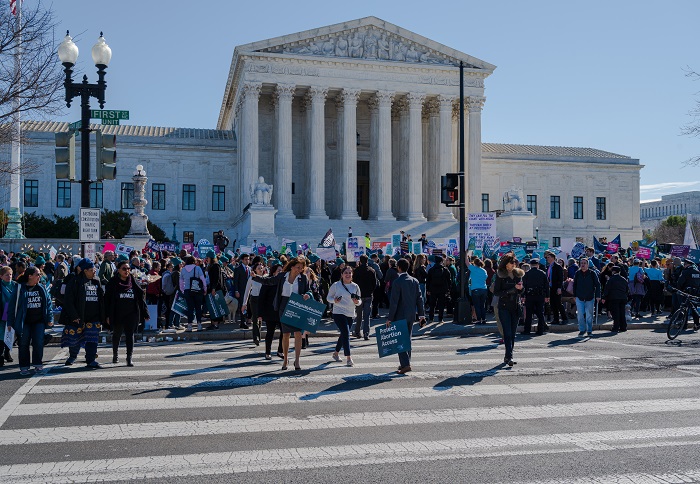
Supreme Court asylum claims
By Michael Macagnone
CQ-Roll Call
(TNS)
Washington (CQ-Roll Call) — A majority of the Supreme Court appeared ready during oral arguments Tuesday to clear the way for a policy seeking to prevent immigrants from presenting asylum claims at the U.S. border with Mexico.
The Trump administration asked the justices to overturn a ruling from the U.S. Court of Appeals for the 9th Circuit that blocked the policy known as “metering,” which has border officials prevent immigrants from crossing into the U.S. to present their asylum claims.
The policy was initially adopted by the Obama administration before being formalized in the first Trump term and then dropped by the Biden administration while the legal challenge moved through the courts.
At the arguments, an attorney for the government said the Trump administration wants the option to restart the policy and asked the justices to resolve the issue now.
The dispute centers on language in the law that allows asylum-seekers to present their claims when the claimant “arrives in” the U.S.
The group representing the asylum-seekers, Al Otro Lado, argued that “arrives in” language should include an immigrant arriving at the port of entry. Attorney Kelsi Corkran frequently referred to it as the “threshold” of the United States.
Throughout the arguments, members of the court’s six-justice conservative majority questioned what problems ruling in favor of the asylum-seekers would cause. Justice Amy Coney Barrett repeatedly pushed Corkran on how far from a port of entry an asylum-seeker could be.
Supreme Court asylum claims
“Could you say that someone arrives in the United States if they’re at a portion of the border that does not have a port of entry? Like, what is it, if it’s not crossing the physical border? What is the magic thing, or the dispositive thing, that we’re looking for where we say, ‘Ah, now that person, we can say, arrives in the United States?’” Barrett said.
Corkran responded that an asylum-seeker should be able to have their claims processed when they arrive at the port of entry, and that the metering policy flouted Congress.
Justices Brett M. Kavanaugh and Neil M. Gorsuch pointed out that ruling in favor of the asylum-seekers on the meaning of “arrives in” would not likely end litigation over the issue.
“As soon as we decide what it means we’re going to get cases,” Gorsuch said.
Kavanaugh also pointed out the Trump administration could take steps to prevent asylum-seekers from reaching whatever line the court draws to present their claims.
“The whole thing seems kind of artificial to me because the government is going, if they want to do this policy, they’re going to stop you on the other side of the line,” Kavanaugh said.
The administration asked the justices to take up the case after a ruling from the 9th Circuit found the law required officials to start processing asylum claims if an applicant presented themselves to officials at the border, rather than on U.S. soil itself.
Justice Department attorney Vivek Suri argued that Congress did not intend to allow asylum-seekers to present their claims from another country, and when they are in Mexico they are the responsibility of Mexican officials.
“You can’t ‘arrive in’ the United States while you’re still standing in Mexico,” Suri said.
Supreme Court asylum claims
Justice Samuel A. Alito Jr. said that someone at the threshold of a port of entry may not be considered to have “arrived in” the United States as laid out in the law.
“So there’s been talk about knocking at the door. Do you think someone who comes to the front door of the house and knocks at the door has arrived in the house? The person may have arrived at the house,” Alito said.
The court’s Democratic appointees repeatedly questioned Suri over whether the administration’s interpretation of the law contradicted treaty obligations based on U.S. ports turning away Jewish refugees aboard the MS St. Louis who were fleeing from Nazi Germany.
Justice Sonia Sotomayor said the law includes provisions allowing asylum-seekers to present themselves at the border and be placed on a list to have their claims processed later.
“Instead, what you were doing was saying, ‘You, alien, we’re not going to even consider your application. We’re not going to take your number. We’re not going to do anything. We’re just going to turn you back. We’re going to be the ship, MS St. Louis, and ship you back to be killed wherever you end up.’ And that’s what the statute doesn’t permit,” Sotomayor said.
Suri argued that U.S. law does not obligate the administration to process asylum claims for people not actually in the country.
The justices will likely issue a decision in the case before the conclusion of the court’s term at the end of June.
The case is Kristi Noem, secretary of Homeland Security, et al. v. Al Otro Lado, a California corporation, et al.
©2026 CQ-Roll Call, Inc., All Rights Reserved. Visit cqrollcall.com. Distributed by Tribune Content Agency, LLC.