
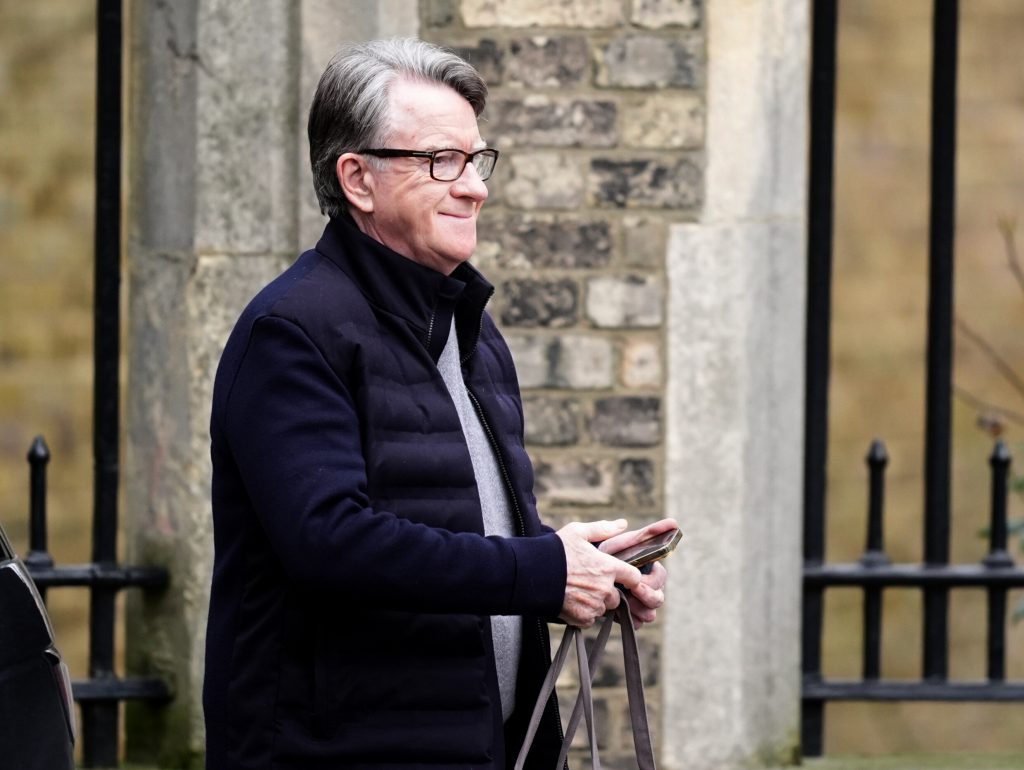
Starmer Mandelson
London — British lawmakers will have the opportunity to scrutinize the government’s accountability in relation to the appointment of Peter Mandelson as US ambassador in an emergency debate on Tuesday.
British Prime Minister Keir Starmer has blamed former top civil servant Olly Robbins for deliberately keeping him in the dark over Mandelson’s failure to pass security vetting checks before taking the role.
The prime minister told the House of Commons he would not have appointed Mandelson if he had known the peer had failed the checks and insisted there was no pressure from No 10 to push through the high-profile appointment.
Conservative leader Kemi Badenoch said it is “a matter of national security because the prime minister has admitted appointing a known serious security risk to our most sensitive diplomatic post,” as she made an application for the debate under standing order 24.
The prime minister fired Robbins from his role as the Foreign Office’s top official after finding out last week that Mandelson had been granted security clearance despite failing the checks.
Starmer Mandelson
Starmer was questioned by lawmakers for more than two hours on Monday, however Badenoch said “there remain serious questions about what he knew and when.”
The prime minister denied misleading the Commons in the face of accusations that he lied to parliament by failing to set out the full picture around how Mandelson was granted developed vetting (DV) status.
“I accept that information that I should have had, and information that the house should have had should have been before the house, but I did not mislead the house, and that’s why I’ve set out the account in full,” he said.
Making her case for an emergency debate, Badenoch told the Commons: “This is a matter of national security, because the prime minister has admitted appointing a known serious security risk to our most sensitive diplomatic post.”
“This goes beyond Mandelson’s close relationship to a convicted paedophile.”
“Today I raised deeply concerning ties to the Kremlin and China, which the prime pinister admitted he knew about before the appointment.”
Starmer Mandelson
“This is why, despite the prime minister’s statement today, there remain serious questions about what he knew and when. He has hidden behind process at every turn and failed to take responsibility.”
She added: “There are also questions to be asked about the prime minister repeatedly sacking senior civil servants on a whim for his own decisions and leaving the taxpayer with financial liabilities.”
Badenoch also called for a debate on comments made by Robbins following his appearance at the Foreign Affairs Committee.
Earlier on Monday, the prime minister said Robbins’s view was “that he couldn’t provide this information to me because he wasn’t allowed to,” which No 10 has claimed is not correct.
Starmer said he challenged Robbins over why he went against the recommendation of UKSV (United Kingdom Security Vetting).
“I did ask him and I didn’t accept his explanation,” Starmer said. “That’s why I sacked him.”
The application was passed unopposed, with Speaker Lindsay Hoyle granting a three-hour debate to take place on Tuesday at the start of public business.
It is not yet clear who will respond to the debate on behalf of the government.
Starmer Mandelson
The prime minister said there were a series of occasions when the information could and should have been disclosed.
He did accept responsibility for the decision to appoint Mandelson, who was sacked after nine months in the job over his links with paedophile financier Jeffrey Epstein.
The architect of New Labour was a political appointment to the plum diplomatic role, rather than the Washington job going to a career diplomat.
Emily Thornberry, Labour chairwoman of the Commons Foreign Affairs Committee, said: “I am afraid to say, doesn’t this look like, for certain members of the prime minister’s team, getting Peter Mandelson the job was a priority that overrode everything else and that security considerations were very much second order.”
Starmer denied this, telling her it was “unforgivable” that the full information about Mandelson’s appointment had not been disclosed.
He said this “wasn’t an oversight” but “a deliberate decision was taken to withhold that material from me” on repeated occasions by the Foreign Office.
Liberal Democrats leader Ed Davey urged the prime minister to resign, telling lawmakers “the only decent thing” for him to do “is to take responsibility.”
Starmer Mandelson
Reform UK’s Lee Anderson and Your Party lawmaker Zarah Sultana were thrown out of the Commons after accusing Starmer of lying and then refusing to comply with Hoyle’s demand to withdraw the accusation.
The prime minister faced repeated questions over a letter from former cabinet secretary Simon Case, from November 2024, which appeared to advise Starmer that security clearances should be done before confirming Mandelson as his choice for the role.
The note said that in the case of a political appointment “you wish to take, you should give us the name of the person you would like to appoint and we will develop a plan for them to acquire the necessary security clearances and do due diligence on any potential conflicts of interest or other issues of which you should be aware before confirming your choice.”
The prime minister insisted the usual process for a political appointment had been followed, but that procedure had been changed after the Mandelson row.
The terms of a probe into government security vetting have been updated in light of the latest revelations about Mandelson and the inquiry will be led by Adrian Fulford, a senior judge and chairman of the Southport Inquiry.
©2026 dpa GmbH. Distributed by Tribune Content Agency, LLC.