
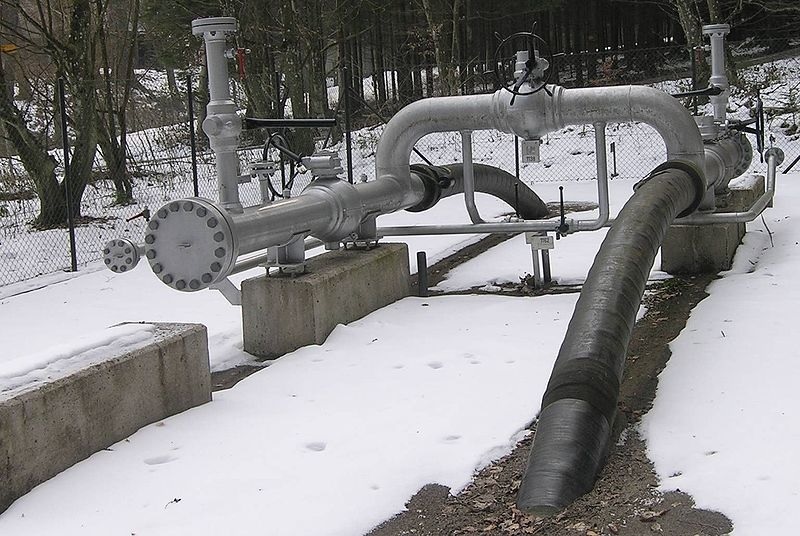
hydrogen pipeline in Germany
Berlin (dpa) — Construction of an interregional hydrogen pipeline network began in Germany in 2025 and is so far meeting its construction deadlines, according to the country’s gas industry association, FNB Gas.
“By the end of the year, the first 525 kilometres of core network pipelines will be completed as planned,” the industry association FNB Gas said in response to a dpa query.
On its website, Germany’s Ministry of Economic Affairs and Energy says hydrogen produced using electricity from renewable energy sources is of “crucial importance for the energy transition.”
“Green hydrogen can replace coal, natural gas and the like in many areas,” the website claims.
When burnt, hydrogen produces water as a waste product rather than carbon dioxide, however its production is energy intensive.
The hydrogen pipelines are largely being converted from existing natural gas lines. Recently, a 400-kilometre pipeline from the Baltic Sea through Brandenburg to Saxony-Anhalt was completed.
Under current plans, the hydrogen core network is to grow to 9,040 kilometres by 2032 and connect key hydrogen locations in all of Germany’s federal states.
The plans envisage around 60% of the route consisting of converted natural gas pipelines. The remaining 40% will be newly built.
Existing pipelines were used for most of the first 525 kilometres. A further 142 kilometres are scheduled for 2026, again primarily using former natural gas pipelines.
Under current planning, 1,521 kilometres are due for completion in 2027. Whether the medium-term expansion plans will remain unchanged is still open.
FNB Gas says that, as an energy carrier, hydrogen is set to play a “central role” in the future economic system alongside electricity from renewable sources.
“It is to generate electricity in new gas-fired power plants when the sun does not shine and the wind does not blow,” the organization said.
©2025 dpa GmbH. Distributed by Tribune Content Agency, LLC.