
commentary
By Ramzy Baroud
The moment a two-week ceasefire between the US and Iran was announced—brokered through Pakistani mediation on April 7—Iran declared that Lebanon was included in the arrangement. It was a clear message: the war could not be compartmentalized, and the fronts were linked.
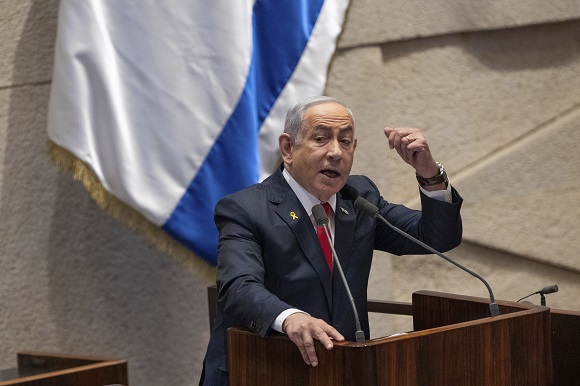
Israeli Prime Minister Benjamin Netanyahu rushed to deny it. But the denial exposed more than it concealed. Lebanon and other resistance fronts were already embedded within Iran’s broader ten-point proposal—a framework the Trump administration had accepted as a workable basis for negotiations set to begin Friday.
Netanyahu was left politically and strategically exposed.
Iran was never just another battlefield. It was the culmination of a long campaign of perpetual war that Netanyahu has sustained for years—beginning with the genocide in Gaza, expanding into Lebanon, and stretching across multiple fronts whenever his political survival demanded escalation.
Each war served a purpose: to silence dissent within his coalition, to distract from collapsing approval ratings, to evade accountability in corruption trials. War became governance.
But the Iran gambit failed. And failure, for Netanyahu, is never an endpoint. It is a trigger. With no victory to claim and no strategic gains to present, he turned—once again—to Lebanon.
Dahiya Doctrine Revisited
On Wednesday, Israeli warplanes unleashed one of the most extensive bombardments of Lebanon in recent memory.
Beirut. Southern Lebanon. The Bekaa Valley. Mount Lebanon. And more. Within just two hours, approximately 150 airstrikes were carried out, according to Lebanese media.
The death toll continues to rise. Entire families buried under rubble. Rescue workers targeted. Funerals struck. Civilian infrastructure pulverized. This is not warfare. It is punishment.
But these attacks are not random. They follow a doctrine—one that Israel has refined and reapplied whenever it seeks to compensate for military failure.
Netanyahu is reinstating the Dahiya Doctrine—a strategy first articulated after the 2006 war against Lebanon.
The doctrine is simple and brutal: use overwhelming, disproportionate force against civilian infrastructure to collectively punish populations believed to support resistance movements.
Entire neighborhoods are treated as military targets. The goal is not precision—it is devastation. The logic is coercion through destruction.
Today, Lebanon is once again its laboratory.
Seven Messages
This escalation is not chaos. It is communication.
First, Netanyahu is asserting that war and peace are his decisions alone. Not Iran’s. Not Washington’s. Not the region’s. The message is clear: no agreement binds him.
Second, he seeks to reimpose fear across the Middle East—at a moment when millions are celebrating what they see as a decisive Iranian victory against the combined power of the US, Israel, and their allies.
Third, he is attempting to fracture the resistance front by suggesting that Iran has abandoned its allies. The goal is to manufacture distrust where unity has just been strengthened.
Fourth, he is providing ammunition to his political allies in Lebanon—and to compliant Arab regimes—who argue that Hezbollah has dragged Lebanon into catastrophe. This narrative is designed to intensify pressure for disarmament.
Fifth, he is distracting from his own failure. Both supporters and critics inside Israel are questioning the outcome of the war with Iran. Thus, Lebanon becomes the diversion.
Sixth, he is masking a military reality: Israel has failed to neutralize Hezbollah’s capabilities. Despite repeated claims, Hezbollah remains operational, resilient, and capable of disrupting Israeli plans along the border. The targeting of civilians is not a strength—it is an admission of limits.
Seventh, Netanyahu is raising the cost ahead of an inevitable settlement. He knows that he cannot defeat Hezbollah outright. By inflicting maximum damage now, he hopes to reshape the political terrain before negotiations he cannot avoid.
The Fragile Ceasefire
Yes, ending the war on Lebanon was embedded in Iran’s conditions for talks. But there are cracks.
Washington can—and likely will—argue that its agreement applies only to US actions, not to Israel, which it portrays as acting independently.
At the same time, Iran’s proposal was the basis for a temporary ceasefire—not a finalized framework for a permanent settlement.
This ambiguity is not accidental. It is the space in which Israel now operates.
Will Israel’s massacres be enough for Iran to declare that the US-Israeli camp has violated the ceasefire?
Or will negotiations proceed, despite the bloodshed in Lebanon?
The answer will shape the next phase of the war. But one lesson is already clear.
Since the beginning of the genocide in Gaza, a pattern has emerged: every time Netanyahu escalates in an attempt to regain the initiative, his adversaries respond in kind—and often with greater strategic effect.
Therefore, his escalation has not delivered victory. Instead, it has deepened Israel’s entanglement.
Lebanon may be burning today, but the war is far from decided. Netanyahu may believe that he is reshaping the battlefield.
History suggests otherwise, because the other side still holds its cards—and this time, at least for now, Washington is not stepping in to tilt the balance.
For they, too, have been forced to step back. And that, more than anything, is what makes this moment so dangerous.
Dr. Ramzy Baroud is a journalist, author and the Editor of The Palestine Chronicle. He is the author of six books. His latest, ‘Before the Flood,’ was published by Seven Stories Press. His other books include ‘Our Vision for Liberation’, ‘My Father was a Freedom Fighter’ and ‘The Last Earth’. Baroud is a Non-resident Senior Research Fellow at the Center for Islam and Global Affairs (CIGA). His website is www.ramzybaroud.net
Notes from APS Radio News
The views and/or opinions of commentators do not necessarily reflect those of APS Radio News or of its affiliate APS Radio.