
an analysis ICE shooting
By Emmy Martin and Sofia Barnett
Star Tribune
(Star Tribune) A federal immigration agent identified as Jonathan Ross shot and killed Renee Good, 37, on the morning of Wednesday, Jan. 7, during an enforcement operation near E. 34th Street and Portland Avenue in south Minneapolis, just blocks from where George Floyd was killed by police more than five years ago.
Here’s what we know about the shooting and its fallout.
Federal immigration agents were in south Minneapolis on the morning of Jan. 7 as part of a stepped-up enforcement presence that has drawn increasing scrutiny and anger in the Twin Cities.
Good was at the scene as an observer of the operation, Minnesota Attorney General Keith Ellison confirmed Jan. 9, inside a Honda Pilot SUV positioned perpendicular to Portland Avenue when federal agents on foot converged on the vehicle.
According to multiple eyewitnesses and video footage, two agents approached the Honda Pilot’s open driver’s-side window, and a third approached from the passenger side, moving to the front. Video shows one agent grabbing the door handle and trying to open the driver’s-side door. In at least one clip, the agent appears to reach a hand through the open window.
A video that appears to have been recorded by Ross and obtained by local conservative media outlet Alpha News shows an individual identified as Good’s wife, Becca Good, standing outside the vehicle, filming and speaking to the agents.
Renee Good is inside the vehicle with her window down and a dog in the back seat. As an agent told Good to “get out of the car,” the video shows Becca Good trying to enter the passenger door and Ross moved to the front of the vehicle. Video and accounts indicate that Good backed up a few feet and began to drive forward, turning the car’s wheels away from the agents.
At that point, the car appears to make contact with Ross, who fired his handgun once through the windshield and at least once through Good’s driver’s-side window as he moved from the front of the vehicle to its side. It’s unclear whether the vehicle hit Ross. Witness video shows the vehicle continued down the street after shots were fired and then struck a parked car.
an analysis ICE shooting
Witnesses also say federal agents prevented a nearby doctor from approaching to provide medical care immediately after the shooting and an emergency vehicle had trouble getting through ICE vehicles to reach Good.
Minneapolis Police Chief Brian O’Hara said during a press conference on Jan. 7 that Minneapolis officers found Good with a gunshot wound to the head. He said officers attempted lifesaving measures, including CPR, before Good was taken by ambulance to Hennepin County Medical Center, where she was pronounced dead.
In the hours after the shooting, Minneapolis police secured the scene and worked to preserve evidence before turning the case over to federal and state investigators. The FBI later took over the case.
Good, a 37-year-old U.S. citizen, lived in south Minneapolis with her wife just blocks from where she was shot and killed. She was identified by her mother, Donna Ganger, who said the family was notified of her death later that morning.
The Hennepin County Medical Examiner’s Office confirmed her identity on Jan. 9.
She had three children: a 6-year-old son with her second husband, who died in 2023, and two other children from her first marriage who live with extended family.
An Instagram account appearing to belong to Good described her as a “poet and writer and wife and mom” who had moved from Colorado and was “experiencing Minneapolis.”
Good graduated from Old Dominion University in Virginia in 2020 with an English degree.
While studying creative writing there, she was described by her department as someone who loved reading, writing, having movie marathons and making art.
Neighbors described Good as a warm presence. Mary Radford, who lived next door, said she often saw Good outside with her young son while walking her dog.
“They’re always outside playing,” Radford said. “We’re gonna miss seeing them — forever.”
an analysis ICE shooting
The ICE agent who fatally shot Good has been identified as Jonathan Ross, according to a law enforcement source with knowledge of the case and confirmed by court records.
Ross has not been publicly named by ICE or the Department of Homeland Security (DHS), which did not respond to requests for comment. Federal officials have described the agent involved only as “experienced.”
Court records show Ross was involved in an incident in June 2025, in Bloomington, Minnesota, in which he was dragged and injured by a fleeing motorist during an arrest. In that case, Ross broke a vehicle window and reached inside to unlock the door after the driver, Roberto Carlos Munoz, a Guatemalan citizen, ignored commands to comply. The driver accelerated, dragging Ross alongside the vehicle for about 300 feet before Ross was thrown free.
Ross suffered serious injuries in that incident, requiring more than 30 stitches, according to court documents. A jury later convicted Munoz of assaulting a federal officer.
Federal authorities have not said whether Ross has been placed on administrative leave or what internal review steps are being taken following the fatal shooting of Good. Homeland Security Secretary Kristi Noem said during a Jan. 8 press conference that the DHS is following standard protocol procedures.
The shooting triggered swift and blunt condemnation from Minneapolis officials.
At a City Hall news conference on Jan. 7, Mayor Jacob Frey said the shooting was devastating and delivered a profane message aimed at federal agents to get out of Minneapolis.
Frey rejected the claim that the shooting was an act of self-defense.
Gov. Tim Walz condemned the federal presence and signaled the state was preparing for instability in a Jan. 7 press conference.
He activated the Minnesota National Guard on the afternoon of Jan. 8. The governor’s executive order said Guard resources will be used “only where local law enforcement resources have been exhausted.”
Walz praised the large crowds who demonstrated peacefully on the previous evening and called on the Trump administration to stop targeting Minnesota.
Rep. Angie Craig and Rep. Tom Emmer got into a heated exchange on the House floor on Jan. 7 about the ICE shooting, finger-pointing and appearing to yell in a moment captured on C-SPAN. Another person stepped between them to break things up, and Rep. Betty McCollum had to pull Craig away from Emmer.
Emmer previously told Fox News he is “not going to jump to conclusions” before a law enforcement investigation but that “there is a ICE officer standing directly in front of the car when it starts to accelerate.”
an analysis ICE shooting
Noem, speaking at a news conference in Brownsville, Texas, a few hours after the Jan. 7 shooting, characterized the incident as an act of “domestic terrorism” and said it reflected the kinds of assaults ICE officers face. She doubled down on her characterization during a news conference in Minneapolis later that day.
In a statement, DHS said ICE agents were making arrests in the area when “rioters began blocking ICE officers and one of these violent rioters weaponized her vehicle.” DHS spokesperson Tricia McLaughlin said an ICE agent, “fearing for his life,” fired “defensive shots,” striking Good.
President Donald Trump claimed in a social media post that Good “ran over” an agent and that the shooting was in self-defense. He repeated the claim in an interview with the New York Times on Jan. 7 that “she didn’t try to run him over. She ran him over,” even as video footage showed Ross did not fall over and walked away.
Vice President JD Vance defended Ross’s actions.
“That very ICE officer nearly had his life ended … six months ago,” Vance said, referring to the car-dragging incident. “You think maybe he’s a little bit sensitive about somebody ramming him?”
At least one prominent federal figure struck a different tone: Trump border czar Tom Homan told CBS News it would be “unprofessional” to comment on the video and said officials should let the investigation play out, though he also described the incident as another example of escalating hostility toward ICE and Border Patrol.
Immediately after the shooting, the Minnesota Bureau of Criminal Apprehension (BCA) said it was collaborating with the FBI to investigate the use of deadly force.
But on Jan. 8, the BCA said federal officials had reversed course and told the state that the investigation would now be conducted solely by the FBI, without BCA assistance. That decision left state authorities without access to key evidence, including Good’s SUV, a shell casing, witness interviews and other evidence collected at the scene.
Hennepin County Attorney Mary Moriarty and Ellison announced an independent state review, along with the BCA, into Good’s killing at a news conference on Jan. 9. They stressed that while Minnesota has legal jurisdiction to consider criminal charges against a federal agent in Hennepin County, state prosecutors currently lack access to the investigative file controlled by the FBI.
an analysis ICE shooting
As part of the review, Moriarty and Ellison announced the creation of a public evidence-submission portal, urging anyone with information related to the shooting to come forward so material can be preserved.
The shooting catalyzed a long day of tension on Jan. 7, which continued into the morning of Jan. 8. Public school classes were canceled in Minneapolis for the rest of the week.
At the shooting site, hundreds of protesters gathered in the early afternoon of Jan. 7 and remained for hours, chanting and demanding that ICE leave. Police closed off several blocks of Portland Avenue as the crowd grew. Witnesses and reporters described shouting, whistles and angry exchanges as law enforcement maintained a perimeter.
Federal agents deployed chemical spray multiple times amid confrontations. There were also moments of physical struggle during crowd movement near police tape.
Wednesday night, a vigil and march drew thousands.
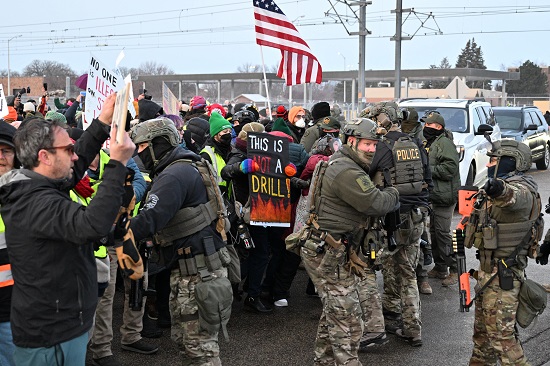
On Jan. 8, protesters mobilized again — this time outside the Bishop Henry Whipple Federal Building in Fort Snelling. Hundreds gathered early and remained late, chanting Good’s name and holding signs calling for accountability. Protesters moved into the road and blocked exits from the federal building’s parking lot as federal agents formed lines in tactical gear, some with gas masks or face coverings and less-lethal weapons.
Chemical spray was deployed again against protesters and at least seven activists were tackled to the ground and arrested by federal agents. Demonstrators described the gathering as a response to what they see as an aggressive show of federal force and a lack of accountability.
As protests continued into the weekend, Minneapolis police arrested, cited and then released 30 protesters on Friday night after they declared their demonstration at the Canopy by Hilton hotel to be an unlawful assembly.
Thousands marched in south Minneapolis on Saturday afternoon to protest the ongoing immigration operation.
(Paul Walsh, Jeff Day, Liz Sawyer, Andy Mannix, Sarah Nelson, Sofia Barnett, Louis Krauss, Kim Hyatt and Elliot Hughes of the Minnesota Star Tribune contributed to this story.)
©2026 The Minnesota Star Tribune. Visit startribune.com. Distributed by Tribune Content Agency, LLC