

grocery prices rose
By Dee-Ann Durbin AP Business Writer
Americans paid more for their groceries last month, but high gasoline prices resulting from the Iran war were only one of the reasons why.
Prices for food eaten at home rose 2.9% in April compared to the same month a year earlier, according to government figures released Tuesday. That was the highest year-over-year inflation rate for the category since August 2023.
Prices at restaurants, fast-food chains and other places to get prepared meals also increased, putting overall food prices up 3.2% in the last year, the Labor Department’s consumer price index showed.
Fuel prices have soared while the Iran war prevents cargo ships from passing through the Strait of Hormuz, a vital corridor for global oil supplies. Diesel fuel powers fishing boats, tractors and the trucks that ship 83% of U.S. agricultural products. As of Tuesday, the average price per gallon was up 61% from a year ago, according to AAA.
The meat, produce and dry goods vendors that supply Sparrow Market, a small independent grocer in Ann Arbor, Michigan, all added fuel surcharges to their deliveries in recent weeks, owner Raymond Campise said. Wholesale prices for meat, produce and some other products also have gone up, he said.
grocery prices rose
“For independent markets operating on narrow margins, even small increases can have a major impact,” Campise said.
The full impact of rising energy costs on food likely has not hit retail grocery prices yet in the U.S., according to Purdue University economists Ken Foster and Bernhard Dalheimer. Higher costs to produce, process, store and transport food can take three to six months to show up on supermarket shelves, where prices typically fall slowly once increased, they said.
“Most of what we’re seeing now in the food price chain probably predates the conflict,” Foster, a professor of agricultural economics, said. “We’re cautiously waiting to see what the June numbers and the May numbers might show as they come out in terms of … the extent to which energy shocks in the Strait of Hormuz and shipping blockades and so forth are going to impact food prices.”
The consumer price index measures changes in what people in U.S. cities paid at retail stores for meat, bread, milk, produce and other grocery staples. Over the last 20 years, grocery prices increased an average of 2.6%, according to the U.S. Department of Agriculture.
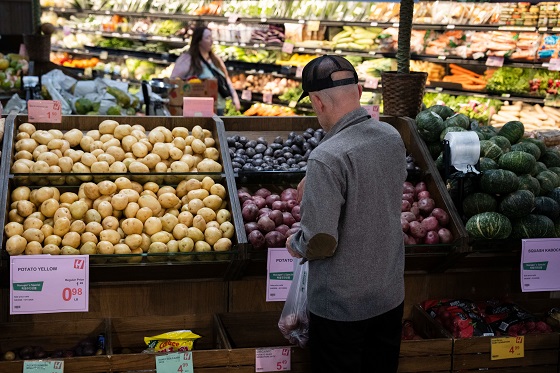
Prices for perishable and refrigerated products tend to increase faster than prices for packaged goods when energy is an issue. Consumers paid 6.5% more for fresh fruit and vegetables in U.S. cities last month than they did in April 2025, and 8.8% more for meat, the Labor Department reported.
grocery prices rose
But U.S. trade policies and extreme weather also have weighed on U.S. food prices in the last year. In July 2025, the Trump administration imposed a 17% duty on fresh tomatoes imported from Mexico; consumer prices rose 40% in the 12 months before April.
Dry weather in the Western U.S. has been one of many factors pushing up beef prices, which in April were 15% higher year-over-year. Coffee prices were up 18.5%, partly due to drought and other weather conditions that have hurt global coffee production in recent years.
“Today’s CPI showed that food prices have been rising 3.2 percent in the past year, but the story behind that number is more complicated than just an energy shock,” said Dalheimer, an assistant professor of macroeconomics and trade in Purdue’s Department of Agricultural Economics.
Prices for some foods remained more or less flat or declined over 12 months. Milk and chicken dipped slightly. Butter cost 5.8% less in April than it did a year earlier. Egg prices fell 39% as farmers rebuilt flocks that were decimated by an ongoing bird flu outbreak.
Food prices and broader inflation are likely to feature prominently in November’s midterm elections. During his 2024 campaign, President Donald Trump often cited the prices of bacon, cereal, crackers and other groceries as reasons why voters should return him to the White House.
Some food producers say they’re struggling now because of higher fuel costs. The Southern Shrimp Alliance, which represents shrimpers in eight states, said some boats haven’t left the dock this spring because they can’t catch enough shrimp to compensate for the cost of diesel.
grocery prices rose
Fuel typically makes up 30% to 50% of the costs for U.S. shrimpers, but because they supply only 6% of the shrimp that Americans consume, they have limited ability to raise prices or add surcharges for fuel, the organization said.
Higher fuel prices may also be impacting food costs in other ways. Part of April’s 5% annual increase in prices for nonalcoholic beverages may be due to the petroleum derivative that goes into making plastic bottles, Foster said.
“It’s possible some of that’s starting to seep down the supply chain and get into those prices,” he said.
Over the next year or more, Americans could also see higher food prices due to spiking fertilizer costs, since around 30% of the world’s fertilizer travels through the Strait of Hormuz.
Fertilizer costs are less of an issue for U.S. farmers this year, since many already had fertilizer supplies in place before the war began, according to Foster. But the effects could become more noticeable next year if the war drags on, he said.
“I expect the Iran conflict to impact the coming years’ food prices through a couple of channels. One, the energy costs and transportation handling. The other would be through packaging costs,” Foster said. “If the conflict were to last longer, then we might see more coming online as fertilizer prices start to impact longer-term planting decisions and cropping decisions.”
Consumer Price Index Summary
The Consumer Price Index for All Urban Consumers (CPI-U) increased 0.6 percent on a seasonally adjusted basis in April,
after rising 0.9 percent in March, the U.S. Bureau of Labor Statistics reported today. Over the last 12 months, the all
items index increased 3.8 percent before seasonal adjustment.
The index for energy rose 3.8 percent in April, accounting for over forty percent of the monthly all items increase. The
shelter index also increased in April, rising 0.6 percent. The index for food increased 0.5 percent over the month as
the index for food at home rose 0.7 percent and the index for food away from home increased 0.2 percent.
The index for all items less food and energy rose 0.4 percent in April. Indexes that increased over the month include
household furnishings and operations, airline fares, personal care, apparel, and education. Conversely, the indexes for
new vehicles, communication, and medical care were among the major indexes that decreased in April.
The all items index rose 3.8 percent for the 12 months ending April, after rising 3.3 percent for the 12 months ending
March. The all items less food and energy index rose 2.8 percent over the year, following a 2.6 percent increase over
the 12 months ending March. The energy index increased 17.9 percent for the 12 months ending April. The food index
increased 3.2 percent over the last year.
Food
The index for food rose 0.5 percent in April after being unchanged in March. The food at home index increased 0.7
percent over the month. Five of the six major grocery store food group indexes increased in April. The index for meats,
poultry, fish, and eggs increased 1.3 percent over the month as the index for beef rose 2.7 percent. The fruits and
vegetables index increased 1.8 percent in April and the nonalcoholic beverages index rose 1.1 percent. The index for
dairy and related products increased 0.8 percent over the month and the index for cereals and bakery products rose 0.1
percent in April.
In contrast, the index for other food at home fell 0.4 percent in April after being unchanged in March.
The food away from home index rose 0.2 percent in April. The index for limited service meals rose 0.4 percent over the
month and the index for full service meals rose 0.1 percent.
The index for food at home rose 2.9 percent over the 12 months ending in April. The fruits and vegetables index rose 6.1
percent over the last 12 months. The index for other food at home increased 2.5 percent over the same period and the
index for nonalcoholic beverages rose 5.1 percent. The cereals and bakery products index increased 2.6 percent over the
12 months ending in April and the meats, poultry, fish, and eggs index rose 1.5 percent over the same period. In
contrast, the index for dairy and related products fell 0.6 percent over the year.
The food away from home index rose 3.6 percent over the last year. The index for full service meals rose 3.8 percent and
the index for limited service meals rose 3.2 percent over the same period.
Energy
The index for energy increased 3.8 percent in April, after rising 10.9 percent in March. The gasoline index increased
5.4 percent over the month. (Before seasonal adjustment, gasoline prices increased 11.1 percent in April.) The index for
electricity rose 2.1 percent in April. The fuel oil index increased 5.8 percent over the month. Conversely, the index
for natural gas decreased 0.1 percent over the same period.
The index for energy increased 17.9 percent over the past 12 months and the index for gasoline rose 28.4 percent. The
electricity index increased 6.1 percent over the last 12 months ending in April and the natural gas index rose 3.0
percent.
All items less food and energy
The index for all items less food and energy rose 0.4 percent in April, after rising 0.2 percent in each of the 2
preceding months. The shelter index increased 0.6 percent over the month. The index for owners’ equivalent rent and the
index for rent both increased 0.5 percent in April. The lodging away from home index rose 2.4 percent over the month.
The index for household furnishings and operations increased 0.7 percent over the month, after rising 0.2 percent in
March. The airline fares index rose 2.8 percent in April and the personal care index rose 0.7 percent. The index for
apparel rose 0.6 percent over the month and the index for education rose 0.2 percent in April. The recreation index and
the motor vehicle insurance index each increased 0.1 percent in April.
The new vehicles index and the communication index each declined 0.2 percent in April. The index for used cars and trucks
was unchanged over the month.
The medical care index decreased 0.1 percent in April, after falling 0.2 percent in March. The index for hospital services
decreased 0.3 percent over the month. Conversely, the physicians’ services index increased 0.6 percent over the month
while the prescription drugs index was unchanged in April.
The index for all items less food and energy rose 2.8 percent over the past 12 months. The shelter index increased 3.3
percent over the last year. Other indexes with notable increases over the last year include medical care (+2.5 percent),
airline fares (+20.7 percent), household furnishings and operations (+3.9 percent), and recreation (+2.3 percent).
Not seasonally adjusted CPI measures
The Consumer Price Index for All Urban Consumers (CPI-U) increased 3.8 percent over the last 12 months to an index level
of 333.020 (1982-84=100). For the month, the index increased 0.9 percent prior to seasonal adjustment.
The Consumer Price Index for Urban Wage Earners and Clerical Workers (CPI-W) increased 3.9 percent over the last 12
months to an index level of 326.541 (1982-84=100). For the month, the index increased 0.9 percent prior to seasonal
adjustment.
The Chained Consumer Price Index for All Urban Consumers (C-CPI-U) increased 3.6 percent over the last 12 months. For
the month, the index increased 0.8 percent on a not seasonally adjusted basis. Please note that the indexes for the
past 10 to 12 months are subject to revision.
The Consumer Price Index for May 2026 is scheduled to be released on Wednesday, June 10, 2026, at 8:30 a.m. (ET).
Brief Explanation of the CPI
The Consumer Price Index (CPI) measures the change in prices paid by consumers for goods and services. The CPI reflects
spending patterns for each of two population groups: all urban consumers and urban wage earners and clerical workers.
The all urban consumer group represents over 90 percent of the total U.S. population. It is based on the expenditures
of almost all residents of urban or metropolitan areas, including professionals, the self-employed, the poor, the
unemployed, and retired people, as well as urban wage earners and clerical workers. Not included in the CPI are the
spending patterns of people living in rural nonmetropolitan areas, farming families, people in the Armed Forces, and
those in institutions, such as prisons and mental hospitals. Consumer inflation for all urban consumers is measured by
two indexes, namely, the Consumer Price Index for All Urban Consumers (CPI-U) and the Chained Consumer Price Index for
All Urban Consumers (C-CPI-U).
The Consumer Price Index for Urban Wage Earners and Clerical Workers (CPI-W) is based on the expenditures of households
included in the CPI-U definition that meet two requirements: more than one-half of the household’s income must come
from clerical or wage occupations, and at least one of the household’s earners must have been employed for at least 37
weeks during the previous 12 months. The CPI-W population represents approximately 30 percent of the total U.S.
population and is a subset of the CPI-U population.
The CPIs are based on prices of food, clothing, shelter, fuels, transportation, doctors’ and dentists’ services, drugs,
and other goods and services that people buy for day-to-day living. Prices are collected each month in 75 urban areas
across the country from about 6,000 housing units and approximately 22,000 retail establishments (department stores,
supermarkets, hospitals, and other types of stores and service establishments). All taxes directly associated with the
purchase and use of items are included in the index. Prices of fuels and a few other items are obtained every month in
all 75 locations. Prices of most other commodities and services are collected every month in the three largest
geographic areas and every other month in other areas. Prices of most goods and services are obtained by personal
visit, telephone call, web, or app collection by the Bureau’s trained representatives.
In calculating the index, price changes for the various items in each location are aggregated using weights, which
represent their importance in the spending of the appropriate population group. Local data are then combined to obtain
a U.S. city average. For the CPI-U and CPI-W, separate indexes are also published by size of city, by region of the
country, for cross-classifications of regions and population-size classes, and for 23 selected local areas. Area
indexes do not measure differences in the level of prices among cities; they only measure the average change in prices
for each area since the base period. For the C-CPI-U, data are issued only at the national level. The CPI-U and CPI-W
are considered final when released, but the C-CPI-U is issued in preliminary form and subject to three subsequent
quarterly revisions.
The index measures price change from a designed reference date. For most of the CPI-U and the CPI-W, the reference base
is 1982-84 equals 100. The reference base for the C-CPI-U is December 1999 equals 100. An increase of 7 percent from
the reference base, for example, is shown as 107.000. Alternatively, that relationship can also be expressed as the
price of a base period market basket of goods and services rising from $100 to $107.
Sampling Error in the CPI
The CPI is a statistical estimate that is subject to sampling error because it is based upon a sample of retail prices
and not the complete universe of all prices. BLS calculates and publishes estimates of the 1-month, 2-month, 6-month,
and 12-month percent change standard errors annually for the CPI-U. These standard error estimates can be used to
construct confidence intervals for hypothesis testing. For example, the estimated standard error of the 1-month percent
change is 0.04 percent for the U.S. all items CPI. This means that if we repeatedly sample from the universe of all
retail prices using the same methodology, and estimate a percentage change for each sample, then 95 percent of these
estimates will be within 0.08 percent of the 1-month percentage change based on all retail prices. For example, for a
1-month change of 0.2 percent in the all items CPI-U, we are 95 percent confident that the actual percent change based
on all retail prices would fall between 0.12 and 0.28 percent. For the latest data, including information on how to use
the estimates of standard error, see www.bls.gov/cpi/tables/variance-estimates/home.htm.
Calculating Index Changes
Movements of the indexes from 1 month to another are usually expressed as percent changes rather than changes in index
points, because index point changes are affected by the level of the index in relation to its base period, while
percent changes are not. The following table shows an example of using index values to calculate percent changes:
Use of Seasonally Adjusted and Unadjusted Data
The Consumer Price Index (CPI) program produces both unadjusted and seasonally adjusted data. Seasonally adjusted data
are computed using seasonal factors derived by the X-13ARIMA-SEATS seasonal adjustment method. These factors are
updated each February, and the new factors are used to revise the previous 5 years of seasonally adjusted data. The
factors are available at www.bls.gov/web/cpi/cpi-seasonal-factors.xlsx. For more information on data revision
scheduling, please see the Seasonal Adjustment questions and answers page at
www.bls.gov/cpi/seasonal-adjustment/questions-and-answers.htm and the Timeline of Seasonal Adjustment Methodological
Changes at www.bls.gov/cpi/seasonal-adjustment/timeline-seasonal-adjustment-methodology-changes.htm.
How to Use Seasonally Adjusted and Unadjusted Data
For analyzing short-term price trends in the economy, seasonally adjusted changes are usually preferred since they
eliminate the effect of changes that normally occur at the same time and in about the same magnitude every year-such as
price movements resulting from weather events, production cycles, model changeovers, holidays, and sales. This allows
data users to focus on changes that are not typical for the time of year.
The unadjusted data are of primary interest to consumers concerned about the prices they actually pay. Unadjusted data
are also used extensively for escalation purposes. Many collective bargaining contract agreements and pension plans,
for example, tie compensation changes to the Consumer Price Index before adjustment for seasonal variation. BLS advises
against the use of seasonally adjusted data in escalation agreements because seasonally adjusted series are revised
annually for five years.
Intervention Analysis
The Bureau of Labor Statistics uses intervention analysis seasonal adjustment (IASA) for some CPI series. Sometimes
extreme values or sharp movements can distort the underlying seasonal pattern of price change. Intervention analysis
seasonal adjustment is a process by which the distortions caused by such unusual events are estimated and removed from
the data prior to calculation of seasonal factors. The resulting seasonal factors, which more accurately represent the
seasonal pattern, are then applied to the unadjusted data.
For example, this procedure was used for the motor fuel series to offset the effects of the 2009 return to normal
pricing after the worldwide economic downturn in 2008. Retaining this outlier data during seasonal factor calculation
would distort the computation of the seasonal portion of the time series data for motor fuel, so it was estimated and
removed from the data prior to seasonal adjustment. Following that, seasonal factors were calculated based on this
“prior adjusted†data. These seasonal factors represent a clearer picture of the seasonal pattern in the data. The last
step is for motor fuel seasonal factors to be applied to the unadjusted data.
For the seasonal factors introduced for January 2026, BLS adjusted 57 series using intervention analysis seasonal
adjustment, including selected food and beverage items, motor fuels and vehicles.
Revision of Seasonally Adjusted Indexes
Seasonally adjusted data, including the U.S. city average all items index levels, are subject to revision for up to 5
years after their original release. Every year, economists in the CPI calculate new seasonal factors for seasonally
adjusted series and apply them to the last 5 years of data. Seasonally adjusted indexes beyond the last 5 years of
data are considered to be final and not subject to revision. For January 2026, revised seasonal factors and seasonally
adjusted indexes for 2021 to 2025 were calculated and published. For series which are directly adjusted using the
Census X-13ARIMA-SEATS seasonal adjustment software, the seasonal factors for 2025 will be applied to data for 2026 to
produce the seasonally adjusted 2026 indexes. Series which are indirectly seasonally adjusted by summing seasonally
adjusted component series have seasonal factors which are derived and are therefore not available in advance.
Determining Seasonal Status
Each year the seasonal status of every series is reevaluated based upon certain statistical criteria. Using these
criteria, BLS economists determine whether a series should change its status from “not seasonally adjusted” to
“seasonally adjusted”, or vice versa. If any of the 81 components of the U.S. city average all items index change
their seasonal adjustment status from seasonally adjusted to not seasonally adjusted, not seasonally adjusted data
will be used in the aggregation of the dependent series for the last 5 years, but the seasonally adjusted indexes
before that period will not be changed. For 2026, 36 of the 81 components of the U.S. city average all items index are
not seasonally adjusted.
Contact Information
For additional information about the CPI visit www.bls.gov/cpi or contact the CPI Information and Analysis Section at
202-691-7000 or cpi_info@bls.gov.