
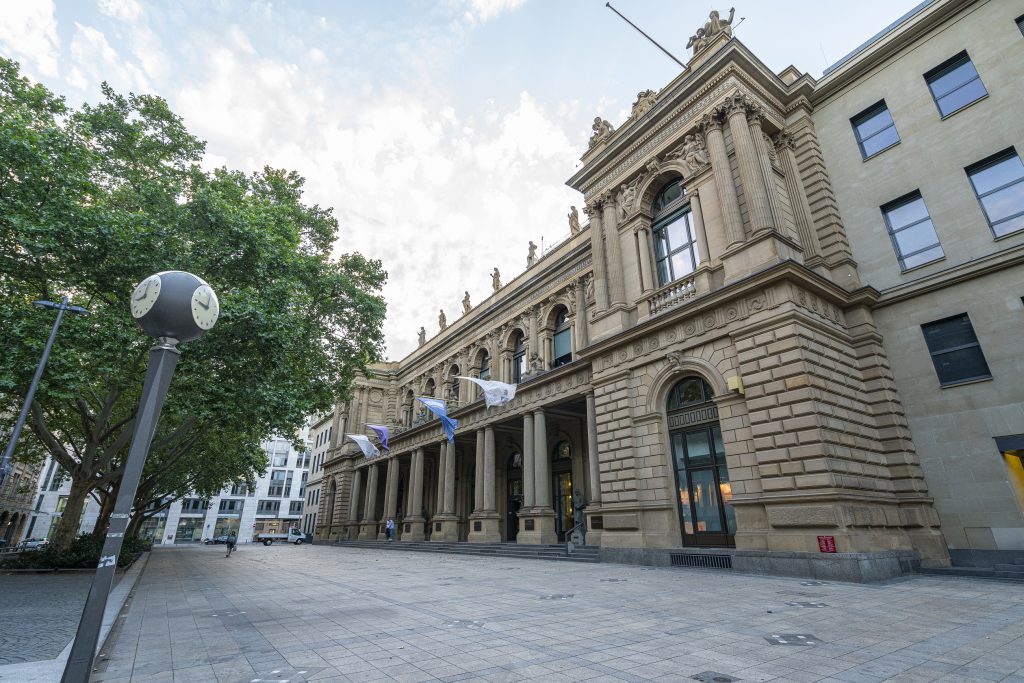
European markets closed mixed
Frankfurt — European stocks turned in a mixed performance on Tuesday as investors largely made cautious moves, tracking geopolitical news, and continuing to weigh recent policy moves of major central banks.
Weak oil prices aided sentiment. Brent Crude futures tumbled to $97.43 a barrel before recovering to around $100.00 a barrel, still down from previous close.
Reports about Iran offering to reopen the Strait of Hormuz within a week if US takes steps to drop military action resulted in oil’s slide.
Addressing the 81st session of the United Nations General Assembly, US President Donald Trump said that while others had spoken about peace, he had “made peace”. “While others have ignored threats, I have confronted them,” he said.
Trump said he has to decide whether to make a deal with Iran or “annihilate” the country.
Meanwhile, investors look ahead to a potential meeting between Iranian President Pezeshkian and Trump.
The pan-European Stoxx 600 ended 0.13% up. Germany’s DAX edged up 0.02%, France’s CAC 40 advanced 0.2% and the U.K.’s FTSE 100 closed down by 0.29%. Switzerland’s SMI ended flat.
European markets closed mixed
Among other markets in Europe, Austria, Finland, Iceland, Ireland, the Netherlands, Portugal, Russia, Spain and Sweden ended higher.
The Czech Republic, Greece, Norway and Turkey closed weak, while Belgium, Denmark and Poland ended flat.
In the UK market, Kingfisher soared 12.5%. The home improvement retailer reported strong first-half results and raised its full-year profit guidance.
Smiths Group climbed 7.5%. JD Sports Fashion surged nearly 6.5%. Coca-Cola HBC, Croda International, Bunzl, Diploma, Coca-Cola Europacific Partners, Antofagasta, Barratt Redrow, Associated British Foods, Metlen Energy & Metals, IAG, Howden Joinery Group and Weir gained 1.6%-3%.
Diageo, Polar Capital Technology Trust, Marks & Spencer, Spirax Group, Endeavour Mining, Unilever, Next, Scottish Mortgage, Computacenter and Anglo American Plc also closed on firm note.
BT Group, Admiral Group, AutoTrader Group, BAE Systems, LSEG, Standard Chartered, Vodafone Group, Aviva, Babcock International, Hiscox, NatWest Group, Airtel Africa, Prudential, M&G, HSBC Holdings, Lloyds Banking Group, Rolls-Royce Holdings, Experian and 3i Group shed 1.4%-4%.
In the German market, Zalando climbed 3.7%. Infineon Technologies, Gea Group, Beiersdorf, Adidas, Henkel, Symrise, MTU Aero Engines, Deutsche Post, Heidelberg Materials, Siemens Energy and Brenntag moved up 1.5%-3.2%.
European markets closed mixed
Allianz dropped about 3.3%. Rheinmetall drifted lower by about 2.4%. Deutsche Bank, Siemens Healthineers and Munich RE also ended notably lower.
In the French market, Bureau Veritas, EssilorLuxottica, STMicroelectronics, Michelin, Pernod Ricard, Saint-Gobain, Unibail Rodamco, ArcelorMittal, L’Oréal, Kering, Air Liquide, Legrand, Eurofins Scientific and Danone gained 1%-2.5%.
Orange closed lower by about 4.1%. AXA ended lower by a little over 2%. Société Générale lost 2.2%
In economic news, the UK budget deficit exceeded the government estimate in August, data from the Office for Budget Responsibility said.
Public sector net borrowing increased GBP 2.9 billion from the previous year to GBP 18.3 billion in August. This was the second-highest borrowing for August on record and also £3.5 billion above the estimate of the Office for Budget Responsibility.
In the financial year to August, borrowing decreased £2.2 billion to £77.3 billion. However, this was £8.1 billion above the OBR forecast.
At the end of August, public sector net debt was equivalent to 93.8% of GDP, was 1.3 percentage points lower than a year earlier.
©2026 dpa GmbH. Distributed by Tribune Content Agency, LLC.
Notes from APS Radio News
From the latter part of February 2020 until the autumn of 2022, the US Federal Reserve embarked on a massive program of monetary expansion, adding about $4.6 trillion to its holdings.
When it does that, in effect, it infuses currency into the economy. It does that by buying back government bonds from participating banks, adding to the credit accounts of those banks.
Even though the Federal Reserve reversed some of that policy, even now the level of holdings is a few trillions of dollars greater than it was in January or February of 2020.
Now, for a number of central banks, the question is how much those entities will raise interest rates and shed some of their holdings, in the context of higher oil prices and substantial increases in inflation during these past several years.