

ICE released some immigrants
By Gregory Royal Pratt
Chicago Tribune
(Chicago Tribune) After being released from nine months in Immigration and Customs Enforcement detention, Jesus Ramirez Ramos needed help.
The clothes he wore when he was arrested stank from spending the better part of a year in storage, unwashed. ICE lost his cellphone at the Michigan jail where he was held, cutting off important contacts. He was arrested and detained far from his Salina, Kansas, home, and had no easy way back to the nation’s heartland.
Or so he thought.
When he walked out of the North Lake detention center in Baldwin, a small town in northern Michigan, Delight Lester was there.
A 66-year old Michigander, Lester is involved with an advocacy group that fills ICE detainees’ commissary accounts, connects them with legal aid, and helps arrange transportation. Through the program, Lester picked Ramos up at the jail in her silver Toyota Prius and drove him more than 900 miles home.
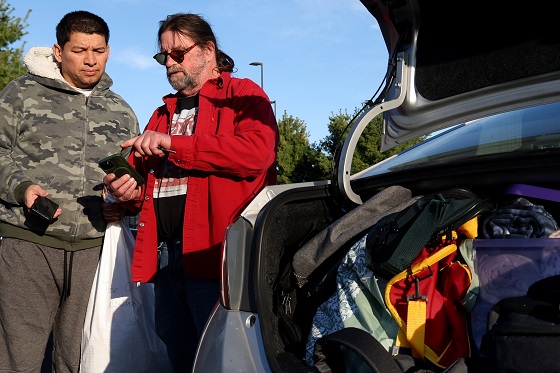
At the jail, Lester greeted Ramos with a change of clothes, a bag of snacks and a phone for the long drive.
“Me ayudó muchísimo. Estoy muy agradecido,” he said. “ She helped me a ton. I’m very grateful.”
ICE released some immigrants
Lester is a small part of a loose network of people across the country who help ICE detainees while they’re in the government’s custody and arrange travel home for those lucky enough to receive bond or win their cases. While some immigrants arrested by ICE are held close to their communities, thousands of others are sent to other states.
From California to New Jersey and Minnesota to Texas, advocates across the country are figuring out ways to get released detainees back home. Some groups have dedicated transportation coordinators who arrange travel, often by throwing out text messages in encrypted messaging apps calling for dedicated volunteer drivers.
In Michigan, one such group is called Hope for Neighbors. In Kentucky, there’s Calor Humano– Human Warmth. Minnesota is represented by Haven Watch. In Illinois, it’s a group of volunteers who call themselves the Overground Railroad and coordinate rides, relay style, from other states to bring people home.
The Tuesday return of Ricardo Hernandez-Navarrete, a Chicago Public Schools senior who was taken to a Kentucky jail after a routine ICE check-in, was facilitated by activists in Kentucky and Indiana. He was able to make it home in time to walk with his Mather High School classmates during their graduation ceremony Thursday.
The networks are a byproduct of the Trump administration’s approach to immigration enforcement, which has led to hundreds of thousands of federal immigration arrests across the country since Donald Trump took office in 2025. Last fall and early winter in Chicago alone, Trump’s deadly Operation Midway Blitz resulted in roughly 3,800 arrests of noncitizens and nearly 2,500 deportations — most of them with no criminal record.
ICE released some immigrants
As the Trump administration attempts to remake the nation’s rules and laws regarding immigration policy, roving bands of often-masked and heavily militarized agents have pushed the boundaries of what constitutes lawful arrests, often detaining people off the street based on the color of their skin, asking questions only later. One of the signature policies of Trump’s second term is a push to indefinitely detain immigrants without allowing them to post bond, no matter what their circumstances.
Those actions have generated fierce legal challenges and criticism from humanitarians. Attorneys across the country are filing habeas corpus petitions to have detained people released, their cases often funded by family members, neighbors and school communities of those who were arrested. But as their cases find success in courtrooms, detainees — who under the Trump administration are being held in jails farther away from their communities than ever before — are often released without notice. Without money or a cellphone. Without a way back home.
Their plight inspired an extraordinary response from everyday Americans across the country.
“When we’re seeing folks getting taken from their family members or taken off their street, it’s such a violent act,” said Evelyn Vargas, an organizer with Organized Communities Against Deportations in Chicago. “It resonates with folks that this is one way or one facet of such a wider impact that we can do something about.”
For Lester, a socially conscious woman who ran an arts center for special needs people for decades before retiring last year, the effort is about spreading hope.
ICE released some immigrants
“It’s not so hard to provide a little light in the dark or a little bit of hope and we should all be doing that every day. Giving a smile away. Giving kindness away. That’s the only way we’ll turn the tide of the hard stuff that’s happening,” Lester said. “For me, we all have the capacity to make the world a little bit better. I think we forget that. We get so caught up in our own lives that we forget how easy it is to make a difference for somebody else.”
‘Hope for neighbors’
Pastor Dale Dalman introduced Lester and her family to the cause.
A former member of his congregation was arrested by federal agents in 2025 and taken to North Lake detention center in Baldwin, Michigan, the largest immigrant jail in the Midwest. Dalman, who lives an hour and 15 minutes away in Rockford, Michigan, went to visit. One trip to the detention center led to more. He told friends about what he was seeing, including lonely people in need of human contact.
His friends responded. Soon, more people wanted to support the immigrants in custody.
“It kind of snowballed into so many people wanting to be involved and wanting to help,” Dalman said. “It was never a plan to start an official ministry or nonprofit but now Hope for Neighbors, we’ve probably got about 250 people involved in our WhatsApp groups and we’re now under a local church.”
The group, based in western Michigan, maintains a storage unit with supplies for people being released or deported. He said they try to help people find lawyers to protect them from attorney scams.
Immigration law and policy can be confusing, Dalman said, because it’s often changing. A number of Venezuelans who came to America seeking asylum under President Joe Biden have experienced rules changes, he said.
“Nobody told them one administration can tear up another administration’s work,” Dalman said. “It’s a tough spot to be in.”
ICE released some immigrants
A signature piece of volunteer effort, he said, is picking up released detainees and driving them to their next stop. Traditional legs of the route are Baldwin to Grand Rapids, Grand Rapids to Lansing, Lansing to Detroit. If a detainee is going to Kansas City, Orlando, New Jersey or elsewhere, he said, the network will fund a bus ticket.
“I’m a follower of Jesus Christ,” Dalman said. “I am completely convinced that this is exactly what he wants me and his followers to do.”
Lillian Khatib, the daughter of Delight Lester, got her family involved with Dalman after seeing a social media post. She’s studying at the University of Michigan for her master’s in social work and speaks Spanish.
Khatib helps coordinate volunteers to come to the center and visit with people who are detained, a crucial part of the mission.
“Everything I’m doing connects to my social work practice,” Khatib said. “I’m sitting with people who are traumatized and holding space for them.”
Her father, Larry Gephart, will regularly drive people to Grand Rapids. The group’s coordinator gives him a list of people who need to be picked up, and he pulls up in his silver Toyota Corolla. He drives them on the first leg of their journey, then says goodbye as they head onto the next.
He compared the logistics of helping people come out of detention with a parable: After high tide, a beach is covered with scores of starfish. A good Samaritan walks along the shore, throwing them back into the water as another man scoffs. There are too many to make a difference, he says. Undeterred, the Samaritan picks up a starfish, throws it into the ocean and says, “I made a difference for that one.”
A national movement
One day, Will Mendoza was camping with friends in rural Kentucky when he saw a message on social media.
ICE released some immigrants
A community racial justice group was asking if anyone was available to pick up an ICE detainee who was being released and needed a ride to Louisville. Mendoza, who lives in Louisville, was heading there anyway, he said, so he was happy to help.
Not long after, it happened again. A call for help posted on the internet. Mendoza asked, “Do we need to figure something out? Do we need to set up a way for them to get home? Is this going to keep happening?”
That’s when Mendoza and others set out to grow the group, a volunteer effort with an underdog spirit.
“The administration, and ICE and DHS, that is their full-time job is putting people away and meeting their quotas,” Mendoza said. “But for the volunteers, we are doing what we can in addition to our various other commitments.”
It’s a challenge for the volunteers, who navigate complex bureaucracy, a hostile federal government and limited resources. It also comes with unexpected stresses, he said.
Recently, an immigrant was released from a Kentucky jail. Because he wasn’t allowed to remain on the premises, he walked off in search of a place to wait. The volunteers looking to pick him up worried about what might happen if he wasn’t found and went to check a nearby restaurant, where the manager had offered the man a drink and a free phone call. It all worked out, Mendoza said, but it highlighted the high stakes and anxiety for the volunteers.
In Minnesota, Natalie Ehret founded Haven Watch, a group that watches the gate at the Whipple federal building for detainee releases.
Susan Schultz, an accountant who lives an eight-minute drive from the Whipple federal building where detainees are released, volunteers with the group.
“We sit at the gate from 7 a.m. to 10 p.m., we have different shifts, and when people are released, we bring them home,” Schultz said. “We give them phones if they don’t have phones. If they have children, we give them stuffies.”
ICE released some immigrants
While many groups have risen in response to Trump’s second term, the effort to help immigrants isn’t new.
Robin Valenzuela helped found Indiana AID in 2019, a group that does similar work in the Hoosier State.
A professor at Western Kentucky University, Valenzuela said she was “in the throes of my dissertation research” and “felt the need to do something more applied, more activist.”
She started volunteering with Freedom for Immigrants, a group in California, and they mentioned to her that Indiana didn’t have an immigrant detention visitation program.
So they started one.
“We do monthly trainings and we could have 20-50 people on a Zoom call (for) each training,” Valenzuela said.
One of their projects is a virtual visit or pen-pal program to help people, even if it’s remotely. Sometimes they send books, which is the only entertainment some detainees have, she said.
Like North Lake in Michigan, the Delaney Hall detention center in New Jersey attracts volunteers from all walks of life. Delaney Hall is a large detention center on the East Coast.
Stephanie Campos, 52, is an adjunct professor in New York who volunteers on the side with an activist coalition in New Jersey called Eyes on ICE.
“We’re there with food, water, diapers, supermarket gift cards. We help translate,” Campos said. “Hold them when they cry.”
She said she is motivated to help “as a child of immigrants.” She is an informal transportation coordinator in her part of the country.
ICE released some immigrants
“Families know to reach out to me if they need transportation somewhere,” Campos said.
She was introduced to the group by Kathy O’Leary, a fellow activist who is often at the facility and drives a Tesla with a bumper sticker that reads, “Here for the clean energy, not the white supremacy.” O’Leary recalled driving away from Delaney on Good Friday when she saw a man leaving in painter’s clothes.
“I pulled over and asked him if he just got released,” O’Leary said. “He was going to Newark so I just gave him a ride.”
The long drive home
In Illinois, Rebecca De La Luz is a veteran of the movement. She started driving from her north-central Illinois home to help immigrant families throughout the Midwest last year, and hasn’t stopped.
The Friday before Memorial Day, De La Luz shifted her Honda Civic into gear and drove east. She roared toward South Haven, Michigan, where she planned to pick up two men for a ride home. Along the way, a new need arose and she agreed to take on a third passenger.
A mother of three and school volunteer who also works with an immigration lawyer, De La Luz drove on the highway, alternating between Nirvana, Latin music — Yailin la Más Viral — and a string of phone calls. She said her phone starts buzzing at 4 a.m. and doesn’t stop until 1 a.m.
The tough conversations usually come when a family’s options are limited. Sometimes, they may not have a clear path to be released or win their case. But sometimes, she gets to deliver good news.
“That’s the best feeling in the world,” De La Luz said. “When I can call someone and say, ‘You’re getting out today or tomorrow.’”
ICE released some immigrants
Her first stop in Michigan was at a South Haven home where the three men sat on the porch with bags of McDonald’s, talking to each other and enjoying their newfound freedom. Lauren Maes, an activist who once paid a detainee’s $50,000 bond, picked them up and drove them down for De La Luz to take home.
After a short conversation, the men moved their bags from Maes’ vehicle to De La Luz’s and took off on a 139-mile journey to Logansport, Indiana, where she drove down a gravel road to a trailer home in the tranquil countryside.
As Luis Peña Martinez got out of the car, his wife and two children walked out of the home to greet him. He was detained when his youngest, Eithan, was just 11 months old. The boy is now a year and a half old.
Looking over at De La Luz, Martinez said, “God bless her.”
The next drop-off was 103 miles away, at a row of modest homes in Chicago’s south suburbs. As Humberto Ramirez Torres stepped onto the parking lot and prepared to reunite with his family, De La Luz called his wife.
“If you come out, I have a present for you,” she said.
Torres’ daughter came to the door, peered through the glass and ran out for a hug. His wife emerged after, her hand over her mouth in joyful shock as they embraced.
“I’m so happy that God heard his prayers and there are people with big hearts to help,” she said.
The last man, Juan Moises Yac-Pastor, was headed back toward her hometown. He hugged Torres farewell, stepped back into the car and they drove off into the night.
©2026 Chicago Tribune. Visit at chicagotribune.com. Distributed by Tribune Content Agency, LLC.